
Trump Faces Backlash From Conservatives and Religious Leaders Over AI Jesus Post and Iran Threats

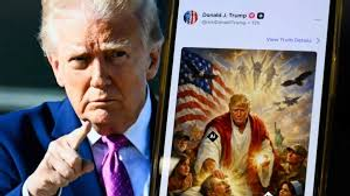
A wave of criticism directed at President Donald Trump this week came not from his usual political opponents, but from some of his own most loyal supporters. Religious leaders, conservative commentators, and members of his own base raised serious concerns after a string of social media posts and escalating military rhetoric that many described as deeply troubling.
The flashpoint was an AI-generated image Trump shared on social media showing himself dressed in robes resembling Jesus Christ, with glowing hands and a demonic figure visible in the background. The post was removed about twelve hours after it went up — an unusually quick reversal for a president known for rarely backing down from anything he puts online.
Conservatives and Catholics Push Back
The loudest voices calling out the post were not Democrats or media critics. They were prominent conservatives and Catholic figures who said the image went too far.
Isabel Brown, a Catholic podcaster with the Daily Wire and a Trump supporter, called the post "frankly, disgusting and unacceptable, and also a profound misreading of the American people experiencing a true and beautiful revival of faith in Christ."
Conservative commentator Riley Gaines, who has spoken at Trump rallies, was equally direct. "I cannot understand why he'd post this. A little humility would serve him well. God shall not be mocked."
Conservative Protestant Christian writer Megan Basham went even further. "He needs to take this down immediately and ask for forgiveness from the American people and then from God."
Rev. James Martin, editor-at-large of the Catholic magazine America, told CNN the image was "the most Jesus-looking picture I think I could imagine" — a direct response to Trump's suggestion that the image depicted a doctor rather than Christ.
Tensions With the Pope
The AI image came shortly after a public clash between Trump and Pope Leo XIV, who made history as the first American-born pope. Trump had labeled the pontiff "weak on crime" and "terrible on foreign policy" after Pope Leo called for peace during Holy Week and objected to Trump's threats against Iran. The Pope responded plainly, saying: "I have no fear of the Trump administration."
Iran Threats Raise Alarm Across Party Lines
Separate from the religious controversy, Trump's statements about Iran drew bipartisan concern in Washington. The president warned publicly that an entire civilization could be erased, language that alarmed members of his own party as well as Democrats. He later extended a military deadline by two weeks and threatened military action against any vessel that challenged a U.S. naval blockade of the Strait of Hormuz.
Critics from both parties described the approach as a conflict without a clear strategy, with shifting timelines and goals that many said weakened the administration's credibility on the world stage.
A Broader Pattern of Controversy
The incidents this week were not isolated. Earlier this year, Trump shared a video that ended with an image depicting Barack and Michelle Obama as apes. He said he had not noticed that portion of the video and offered no apology. Following the reported murder of director Rob Reiner and his wife, Trump posted a message mocking the filmmaker instead of expressing condolences.
The accumulation of these events has prompted rare public criticism from people who have long been aligned with or supportive of the president. Retired military generals, former diplomats, and former media allies have openly questioned his behavior and judgment. Former White House lawyer Ty Cobb, who served during Trump's first term, described him as "clearly insane."
A Reuters/Ipsos poll from February found that 61 percent of Americans believe Trump has become more erratic as he has aged. This week, Democrats in Congress introduced legislation that would create a formal commission to evaluate the president's mental fitness. The measure is expected to be blocked by the Republican majority in Congress, but the proposal drew significant public attention given how widely the underlying concerns have spread.